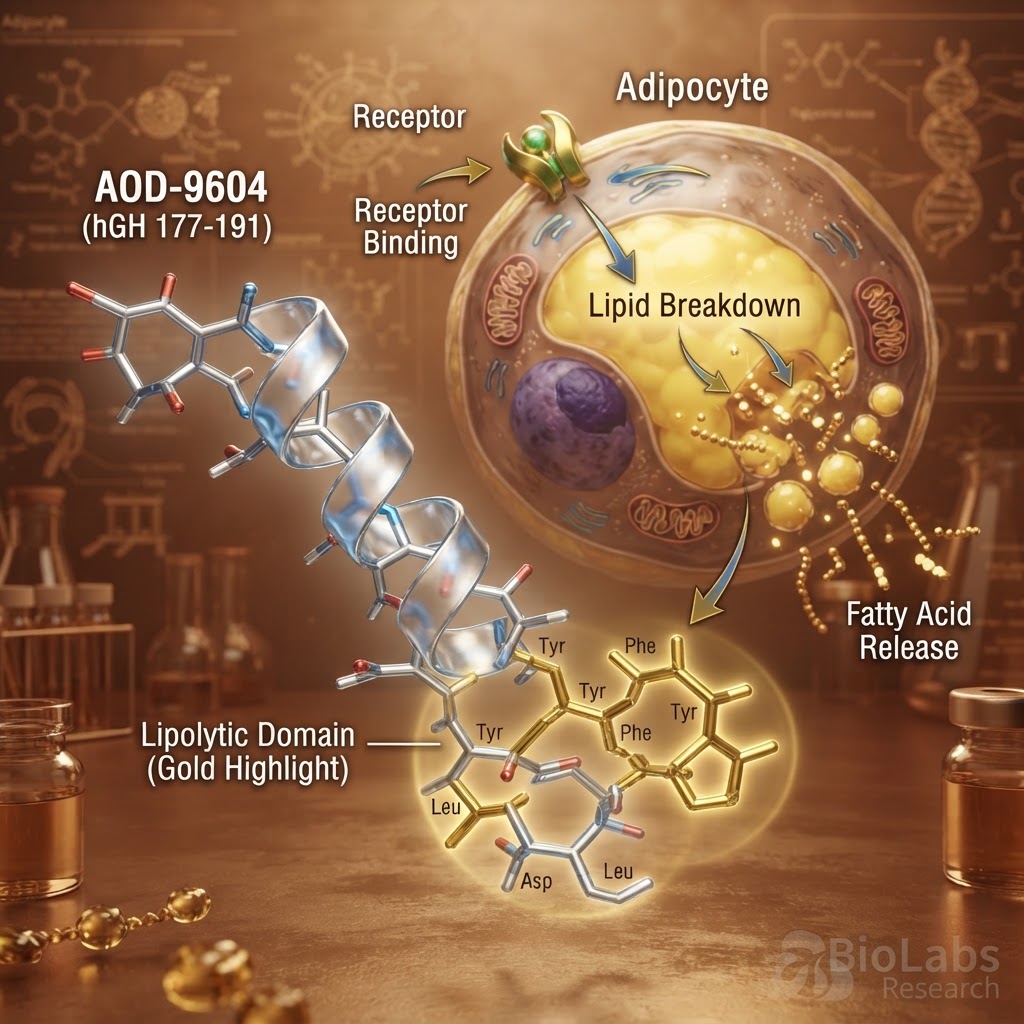
AOD-9604 (hGH 177-191): the lipolytic fragment of human growth hormone, shown wi
Catalog names in this class get reused until they stop meaning anything. “AOD-9604,” “hGH 177–191,” “hGH 176–191,” and “fragment 176–191” are not automatically the same reagent. If the vial, the COA, and the purchase order disagree on the N-terminus or the disulfide, the experiment is not the listing you thought you bought.
This article is an identity note for laboratory sourcing. It does not discuss human use, body-weight protocols, or sports applications. The code name AOD-9604 comes from a discontinued medicinal-product development program. A catalog line with that name is still a laboratory reagent, not a licensed medicine.
The published listing
AOD-9604 is described in the chemical literature as a 16-residue analogue of the C-terminal region of human growth hormone, with an extra N-terminal tyrosine relative to the native 177–191 stretch, and an intramolecular disulfide between the two cysteines.1
| Field | Public listing (literature / registry) |
|---|---|
| Common name | AOD-9604 (Tyr-hGH 177–191) |
| CAS | 221231-10-3 |
| Residues | 16 amino acids |
| Sequence (one-letter) | YLRIVQCRSVEGSCGF |
| Disulfide | Cys7–Cys14 (intramolecular) |
| Formula (free peptide, as commonly listed) | C78H123N23O23S2 |
| Nominal MW | ~1815 Da (intact peptide; salt form changes the cake) |
Those numbers belong on the label as a claim about which molecule is being sold. They are not a purity. They are not a lot. Salt (TFA vs acetate) and net peptide content still have to come from the COA, as in the HPLC note.
Where catalogs mix names
Native hGH 177–191 begins with phenylalanine, not tyrosine. AOD-9604 is the tyrosine-extended / Tyr-substituted analogue used to stabilize that C-terminal fragment in published synthetic work.1 A vendor who prints “hGH 176–191” or “fragment 176–191” on a vial labeled AOD-9604 has not told you which N-terminus you have.
Two practical checks:
- Sequence line on the COA. It should match YLRIVQCRSVEGSCGF (or the fully written Tyr-Leu-Arg-…) if the PO said AOD-9604. A Phe start is a different listing.
- Intact mass. Tyr vs Phe is a 16 Da class difference at the N-terminus, before you even argue about disulfide or salt. If observed mass is not argued against a stated theoretical mass, you do not have identity.
CAS 221231-10-3 is the registry number used for this analogue in common chemical indexes. Older papers sometimes print other registry numbers for related fragments. If a COA’s CAS and the sequence line disagree, believe the sequence and the mass, then send the lot back.
What the name is not
AOD-9604 is not intact growth hormone. It is not a GH-receptor ligand in the sense of 191-residue somatropin. It is not interchangeable with a “176–191” bottle from a different shop. The historical development code is not an approval, an MHRA licence, or an FDA finding. We will not recap clinical endpoints here; those papers are easy to find and they are not a reason to buy a reagent.
What we put on the catalog card
The AOD-9604 catalog page lists the fragment as a laboratory reagent, with public identifiers and “lot COA on request.” We do not invent an HPLC area% on that page. If you need quantitative work, ask for the lot’s HPLC method, observed mass, and net peptide content — the same three numbers as any other lyophilized peptide.
Related lab notes: HPLC area% vs net peptide content and How a Serious Lot Is Read.
Strength does not come from the body. It comes from the will.
AOD-9604 listing
Research-use-only reagent. Sequence and CAS as public identity. Lot paper on request.
View AOD-9604 →References
- National Center for Biotechnology Information. PubChem Compound Summary for CID 71300630, Aod-9604. Sequence YLRIVQCRSVEGSCGF; CAS 221231-10-3; formula C78H123N23O23S2; MW 1815.1 g/mol. https://pubchem.ncbi.nlm.nih.gov/compound/71300630
- Stier H, Vos E, Kenley D. Safety and tolerability of the hexadecapeptide AOD9604 in humans. J Endocrinol Metab. 2013;3(1-2):7–15. Names the analogue as Tyr-hGH 177–191. Cited for that chemical description only, not as a use recommendation. https://doi.org/10.4021/jem157w
This catalog does not sell AOD-9604 as a drug.