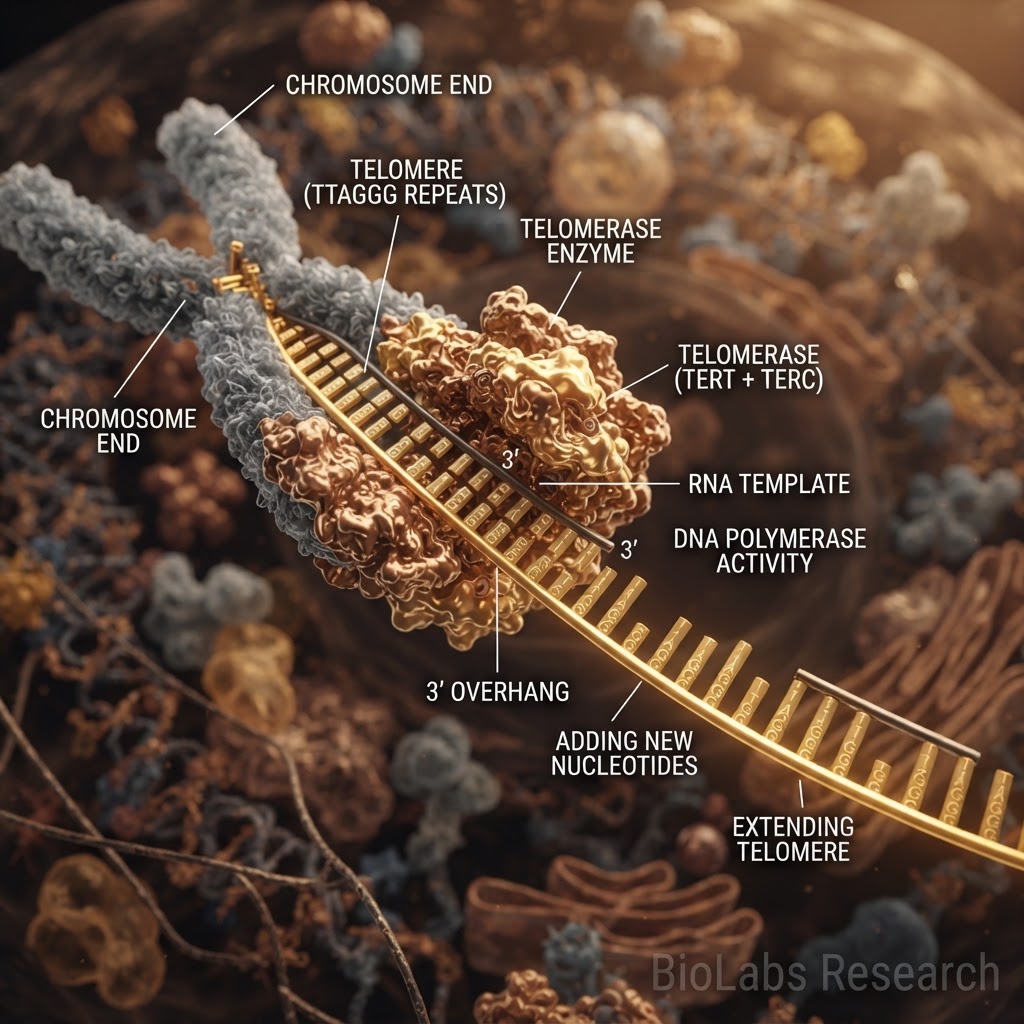
Telomerase activation: Epithalon's proposed mechanism — extending telomeres at c
Epithalon (also spelled Epitalon) is a synthetic tetrapeptide (Ala-Glu-Asp-Gly) derived from the pineal gland peptide Epithalamin. It has been studied primarily in the context of telomerase activity and cellular aging research. This article provides a research-only overview.
Chemical Identity
Epithalon has the amino acid sequence Ala-Glu-Asp-Gly (AEDG). Its molecular weight is approximately 390.3 Da. It is typically supplied as a lyophilized powder for laboratory reconstitution.
Telomerase Research
The primary research interest in Epithalon relates to its potential effect on telomerase, the enzyme that maintains telomere length. Telomere shortening is associated with cellular senescence and aging. Research contexts include:
- Telomerase activation studies — in vitro assays measuring telomerase reverse transcriptase (TERT) expression
- Telomere length measurement — qPCR-based telomere length analysis in cell culture models
- Senescence markers — p16, p21, and SA-β-gal expression in aging cell models
Research Applications
Cellular Aging Models
Epithalon has been studied in fibroblast and epithelial cell aging models, examining telomere dynamics and replicative senescence. Key research questions include whether Epithalon influences TERT expression and whether this translates to measurable changes in telomere maintenance.
Pineal Gland Research
As a derivative of Epithalamin (a pineal gland extract), Epithalon has been studied in the context of pineal function and melatonin regulation in endocrine research models.
Immune System Research
Some research has examined Epithalon's effects on immune cell markers and thymic function in aging models, given the pineal-thymus axis hypothesis.
Sourcing Epithalon for Research
- Purity — see lot COA (HPLC/MS); no catalog-wide %
- Sequence confirmation — mass spec on COA
- Storage — -20°C, protect from light
- Lot documentation — request COA before purchase
Epithalon vs. Other Longevity Research Peptides
Epithalon is often compared with other peptides studied in aging research. Unlike NAD+ (a coenzyme for sirtuins) or MOTS-c (a mitochondrial-derived peptide), Epithalon's proposed mechanism involves telomerase. Each targets different pathways in aging research. See our Epithalon listing, NAD+, and MOTS-c for details.
It is not the years in your life but the life in your years that counts. — Adlai E. Stevenson
Source Epithalon for Your Research
Tetrapeptide for aging research. Lot COA on request. RUO only.
View Epithalon Catalog Listing →