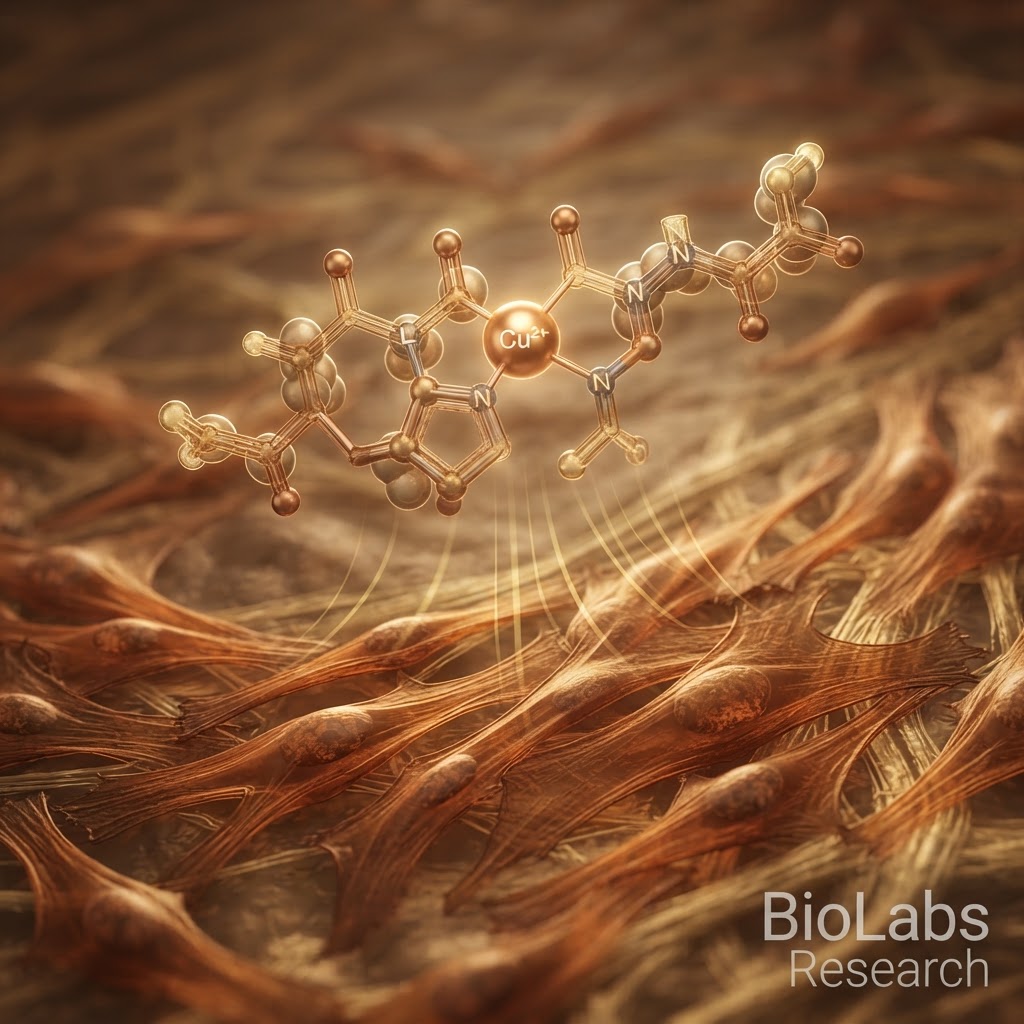
GHK-Cu complex: copper ion (Cu²⁺) bound to the tripeptide Gly-His-Lys — the stru
GHK-Cu (glycyl-L-histidyl-L-lysine copper complex) is a naturally occurring copper-binding tripeptide first isolated from human plasma in 1973. It has been extensively studied in wound healing, tissue repair, and dermatological research. This article provides a research-only overview — no therapeutic or cosmetic claims are made.
Chemical Identity
GHK is a tripeptide with the sequence Gly-His-Lys. It has a high affinity for copper(II) ions, forming the GHK-Cu complex. The copper ion is coordinated by the imidazole nitrogen of histidine, the terminal amine of glycine, and the terminal amine of lysine. Molecular weight of the GHK-Cu complex is approximately 340.3 g/mol.
Natural Occurrence
GHK-Cu is found in human plasma, saliva, and urine. Its concentration in plasma decreases with age — from approximately 200 ng/mL at age 20 to approximately 80 ng/mL at age 60. This age-related decline has driven research interest in GHK-Cu in aging and tissue regeneration studies.
Research Applications
Wound Healing Research
GHK-Cu has been one of the most studied peptides in wound healing models. In vitro research has examined:
- Fibroblast proliferation and collagen synthesis stimulation
- Modulation of metalloproteinases (MMPs) and their inhibitors (TIMPs)
- Angiogenesis in wound models
- Inflammatory cytokine modulation during tissue repair phases
Dermatological Research
GHK-Cu is studied in skin biology research, particularly:
- Collagen and elastin production in dermal fibroblast cultures
- Keratinocyte proliferation and differentiation
- Skin barrier function and repair models
- UV damage protection and repair mechanisms in vitro
Hair Follicle Research
Some research has examined GHK-Cu's influence on hair follicle biology in vitro, including studies on follicle cell proliferation and the hair growth cycle.
Anti-Inflammatory Signaling
GHK-Cu has been studied for its effects on inflammatory signaling pathways, including modulation of TGF-beta and TNF-alpha in cell culture models.
Sourcing GHK-Cu for Laboratory Research
When sourcing GHK-Cu for research, key considerations include:
- Copper complex confirmation — the COA should confirm the copper-complexed form, not just free GHK peptide
- Purity — see lot COA (HPLC/MS); no catalog-wide %
- Storage — store lyophilized GHK-Cu at -20°C; protect from light and moisture
- Lot documentation — request a COA with mass spec confirmation
GHK vs. GHK-Cu: What's the Difference?
Free GHK (the tripeptide without copper) and GHK-Cu (the copper complex) have different properties. Most wound healing research has been conducted with the copper-complexed form (GHK-Cu). When sourcing, verify that the product is GHK-Cu specifically, not free GHK. Our GHK-Cu listing specifies the copper-complexed form.
Healing is a matter of time, but it is sometimes also a matter of opportunity. — Hippocrates
Source GHK-Cu for Your Research
Copper-complexed tripeptide. Lot COA on request. RUO only.
View GHK-Cu Catalog Listing →