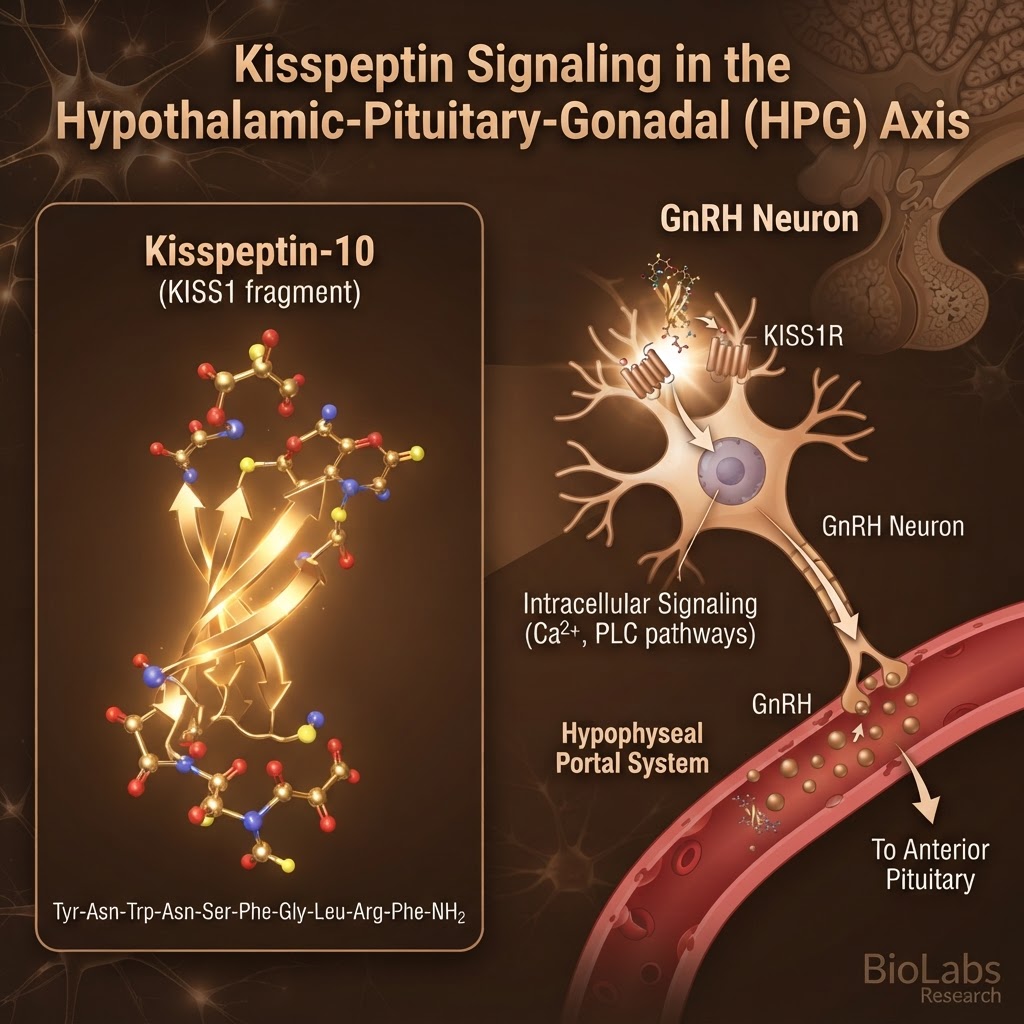
Kisspeptin-10: the KISS1 gene fragment that bridges hypothalamic signaling and r

Reproductive health: the human context where kisspeptin's hypothalamic signaling
Kisspeptin-10 is the C-terminal decapeptide of the KISS1 gene product, listed as an amide: YNWNSFGLRF-NH2. It is not kisspeptin-54 (metastin). It is not the 54-residue secreted peptide with a free or differently processed N-terminus. A catalog line that says “kisspeptin” without a residue count and a C-terminal statement has not identified the reagent.
This note is chemical identity for laboratory purchasing. It is not a fertility product page, not a hypothalamic-protocol, and not a selling document for reproductive endocrinology clinics. The 2001 Nature paper is cited because it identified the peptide ligand of a GPCR — receptor and identity, not an indication.
The published decapeptide amide
PubChem indexes kisspeptin-10 as CID 25240297. The computed formula is C63H83N17O14 and the molecular weight is 1302.4 g/mol. The public CAS for this amide listing is 374675-21-5.1
| Field | Public listing (PubChem / common catalogs) |
|---|---|
| Common name | Kisspeptin-10; KP-10; metastin (45–54) amide |
| Sequence | YNWNSFGLRF-NH2 |
| C-terminus | Amide (part of the listing) |
| PubChem CID | 25240297 |
| CAS | 374675-21-5 |
| Formula | C63H83N17O14 |
| MW | 1302.4 g/mol |
| Not this listing | Kisspeptin-54; free-acid C-terminus |
The amide nitrogen count in C63H83N17O14 is the C-terminal carboxamide plus the side-chain nitrogens of Asn, Arg, and the N-terminus. A free-acid analogue replaces that carboxamide with a carboxylic acid and is a different formula. Do not file them as the same CAS.
It is not kisspeptin-54
KISS1 encodes a precursor. The secreted 54-residue peptide (metastin / kisspeptin-54) and the C-terminal 10-mer are related by proteolysis, not by identity. Kisspeptin-54 is a different length, a different mass, and a different catalog line. A vendor who prints “kisspeptin” on a 10-mer vial and a 54-mer vial interchangeably has not done identity work.
Residue-count checks:
- Ten residues, one-letter YNWNSFGLRF, C-terminal amide — this listing.
- Fifty-four residues — a different PO. Do not accept a 10-mer COA against a 54-mer order, or the reverse.
- Kisspeptin-13 or -14 fragments, when sold, are still other lengths. They are not a substitute mass for KP-10.
If the intact mass on the COA is in a 5–6 kDa class, you do not have kisspeptin-10. If it matches ~1302 Da for the amide, you still need the sequence line, because other decapeptides exist.
The C-terminal amide is identity, not decoration
The listing on this catalog includes the C-terminal amide. That is a structural feature, not a marketing suffix. A free-acid C-terminus (YNWNSFGLRF-OH) is a different molecule: different formula, different mass, different CAS if one has been assigned, and a different ion on the mass spec. Labs that “don’t worry about the amide” are not running the same chemical.
The COA must say -NH2 or “C-terminal amide” in words, and the theoretical mass must be the amide mass. If the paperwork says amide and the observed mass is the free-acid class, send the lot back. We will not treat amidation as optional on this SKU.
Receptor ligand history (Ohtaki, 2001)
Ohtaki and colleagues showed that the KISS1 gene product encodes a peptide ligand of a G-protein-coupled receptor, work published in Nature in 2001.2 That paper is the identity story for this ligand class: a metastasis-suppressor gene name, a secreted peptide, a GPCR. It is cited here as receptor/identity literature, not as a fertility-clinic selling document, and not as a human protocol.
Subsequent work split the ligand into length variants (54, 14, 13, 10). Catalogs inherited those numbers as SKU names. The number is a residue count. It is not a dose, not a purity, and not a license.
What the lot COA must show
Sequence YNWNSFGLRF with an explicit amide, CAS 374675-21-5 if a registry number is given, theoretical mass near 1302.4 Da for the free peptide (salt form still changes the cake), observed intact mass, and an HPLC method for area%. Asn deamidation is a process risk on this sequence; it is a mass and a chromatogram question, not a paragraph we will invent numbers for.
Related notes: HPLC area% vs net peptide content and How a Serious Lot Is Read.
KISS1R is a receptor name, not a product claim
The receptor for this ligand class is KISS1R (previously GPR54). Naming the receptor is identity: it tells a methods section which GPCR assay the decapeptide amide is used in. It is not a fertility clinic claim, not an ovulation protocol, and not a reason to skip the amide versus free-acid check. A lot with the wrong C-terminus is the wrong ligand even if the one-letter code looks familiar.
Trp and Asn on this chain are process-risk residues (oxidation, deamidation). Those are COA questions — extra peaks, extra masses — not percentages this article will invent. If the observed intact mass is not argued against the amide theoretical mass, you do not yet have kisspeptin-10.
Health is the greatest gift, contentment the greatest wealth. — Buddha
Kisspeptin-10 listing
Research-use-only decapeptide amide YNWNSFGLRF-NH2. Not kisspeptin-54. Lot paper on request.
View Kisspeptin-10 →References
- National Center for Biotechnology Information. PubChem Compound Summary for CID 25240297, Kisspeptin-10. Formula C63H83N17O14; MW 1302.4 g/mol. https://pubchem.ncbi.nlm.nih.gov/compound/25240297
- Ohtaki T, Shintani Y, Honda S, et al. Metastasis suppressor gene KiSS-1 encodes peptide ligand of a G-protein-coupled receptor. Nature. 2001;411:613–617. Cited for receptor/identity of the KISS1 ligand, not as fertility selling. https://doi.org/10.1038/35074504