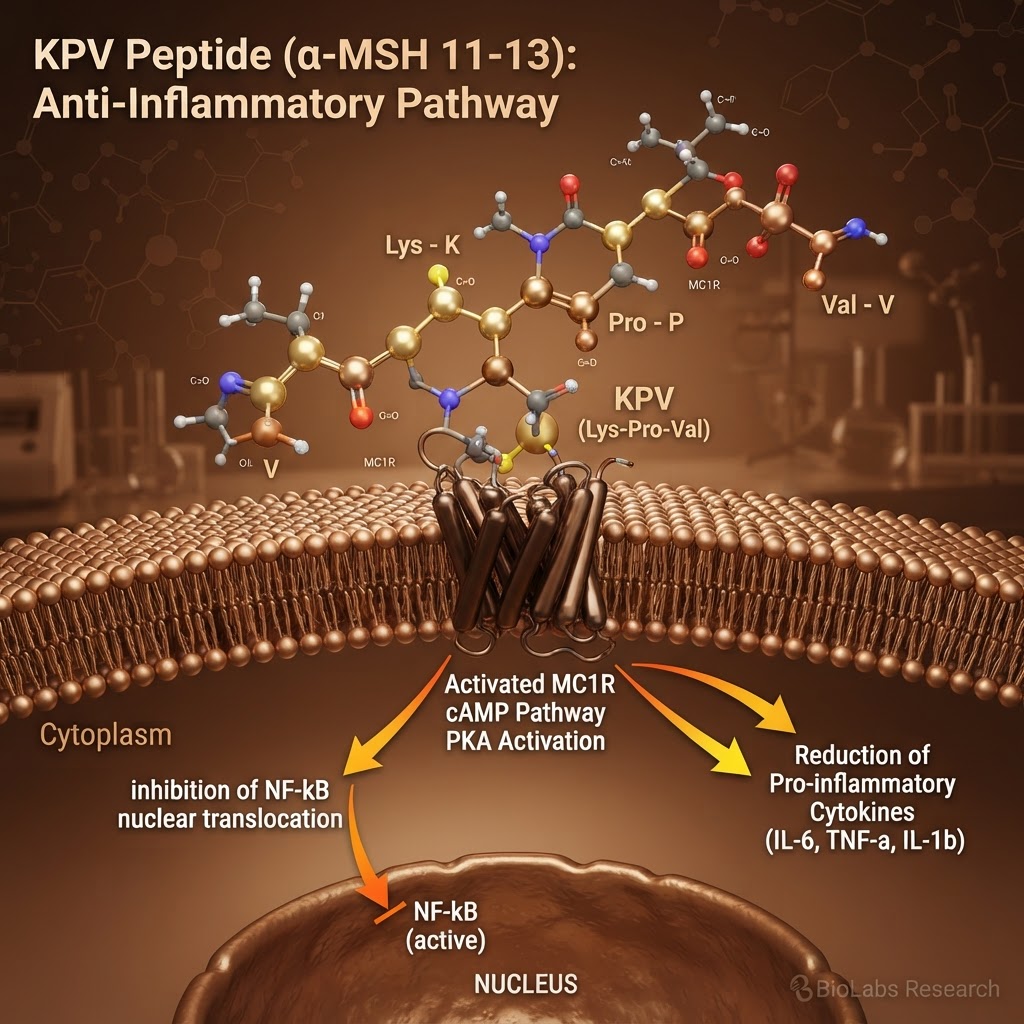
KPV (α-MSH 11-13): the C-terminal tripeptide of alpha-melanocyte-stimulating hor
Catalog cards often print “KPV” as if that three-letter code were a hormone. It is not. KPV is the C-terminal tripeptide of α-melanocyte-stimulating hormone (α-MSH): residues 11–13, Lys-Pro-Val. Intact α-MSH is a 13-residue peptide with its own N- and C-terminal chemistry. A vial labeled KPV is a claim about a fragment, not a claim about the parent hormone.
This note is laboratory chemical identity for purchasing and QC. It does not discuss human use, dermatology protocols, or anti-inflammatory products. Public registry numbers and a 1990 fragment paper are cited so a buyer can match the bottle to a molecule. Lot identity is still the sequence and the observed mass on the COA when one is issued.
The published tripeptide
PubChem indexes the free-acid tripeptide as CID 125672, titled as MSH (11–13). The computed formula is C16H30N4O4 and the molecular weight is 342.43 g/mol. The one-letter sequence is KPV; the three-letter line is H-Lys-Pro-Val-OH.1
| Field | Public listing (PubChem / ChemIDplus) |
|---|---|
| Common name | KPV; α-MSH (11–13); MSH (11–13) |
| Sequence | KPV / H-Lys-Pro-Val-OH |
| PubChem CID | 125672 |
| CAS (public registry) | 67727-97-3 |
| Formula (free acid) | C16H30N4O4 |
| MW (free acid) | 342.43 g/mol |
| Parent hormone | α-MSH is a 13-mer; KPV is not that 13-mer |
Those fields answer “which molecule is being named.” They do not answer how much of that molecule is in the cake, which salt it is, or whether the lot is the free acid or a capped analogue. That is COA work. See HPLC area percent vs net peptide content.
CAS 67727-97-3, not 67747-97-3
The public registry number for this tripeptide, as carried on PubChem CID 125672 and in ChemIDplus, is 67727-97-3.1 A transposed digit string, 67747-97-3, has appeared on some storefronts — including, at the time this note was written, the spec strip on this site’s KPV product page. That is a transposition of two digits (27 vs 47). It is not a second compound.
This article uses 67727-97-3. If a purchase order, a vial label, and a COA disagree on the CAS, believe the sequence and the intact mass, then require the paperwork to be corrected. Registry numbers are indexes, not a substitute for observed mass. A lab that copies a transposed CAS into a methods section has copied a typo, not a specification.
We flag the transposition here so a sourcing file can record the public number and the reason a page once printed something else. Do not treat 67747-97-3 as an alternate CAS for KPV.
Free acid vs Ac-KPV-NH2
The PubChem record cited above is the free-acid tripeptide: a free N-terminus (Lys) and a free C-terminus (Val-OH). A large share of the melanocortin-fragment literature instead uses N-acetyl, C-amide KPV — written Ac-KPV-NH2 or Ac-Lys-Pro-Val-NH2. That capped analogue is a different molecule. Acetylation and C-terminal amidation change the elemental formula and the intact mass. They are not a “form” of the same CAS line.
A lot COA that only says “KPV” has not told you which terminus chemistry you weighed. The COA must state, in words, whether the lot is H-Lys-Pro-Val-OH, Ac-Lys-Pro-Val-NH2, or some other cap, and it must report a theoretical mass that matches that statement. If the label says free acid and the mass matches a capped analogue, the lot is misidentified. We will not invent the capped analogue’s mass here; calculate it from the structure you actually ordered, then match the observed ion.
What α-MSH is, and what KPV is not
α-MSH is a tridecapeptide derived from pro-opiomelanocortin. In the conventional numbering, residues 11–13 of that hormone are Lys-Pro-Val. Cutting those three residues out and selling them as a synthetic tripeptide does not give you α-MSH. It does not give you ACTH. It does not give you a melanocortin-receptor agonist by default — receptor pharmacology is a different experiment, with a different molecule on the dish.
Name collisions to reject on a purchase order:
- “KPV” used as a synonym for α-MSH or “melanotan” class listings.
- A sequence line that is not KPV (or the fully written Lys-Pro-Val).
- A mass that only makes sense for a 13-mer, a longer MSH analogue, or a capped tripeptide when the PO said free acid.
If two vendors both print “KPV” and only one prints H-Lys-Pro-Val-OH with a matching mass, they are not selling the same reagent.
Hiltz and Lipton, 1990: fragment history, not a use claim
Hiltz and Lipton reported that α-MSH peptides, including C-terminal fragments, were studied in models of acute inflammation and contact sensitivity in 1990.2 The paper is cited here as identity and history of the fragment name in the peptide literature — the reason catalogs inherited the letters KPV — not as evidence that a research reagent treats anything, and not as a protocol. BioLabs Research does not sell KPV as an anti-inflammatory product.
Older papers sometimes write “MSH (11–13)” rather than “KPV.” That is the same residue span. It is still not the 13-mer. When you file the citation next to a lot, file it as a name origin, not as a certificate of analysis.
What belongs on the lot COA
For this listing, a usable lot document names the terminus chemistry, the sequence, a theoretical mass, an observed mass, and the HPLC method used for the area% of the main peak. Net peptide content and counter-ion (TFA vs acetate) matter if the work is quantitative. None of those figures are printed as a house percentage on the catalog card.
- Lot number matching the vial.
- Sequence written as KPV or H-Lys-Pro-Val-OH, plus a clear free-acid vs Ac-/NH2 statement.
- CAS 67727-97-3 if a registry number is given — not the transposed 67747 string.
- Intact MS: theoretical and observed.
- HPLC: wavelength, method ID, area% for the main peak, without pretending area% is milligrams of peptide.
Related lab notes: HPLC area% vs net peptide content and How a Serious Lot Is Read.
The greatest wealth is health. — Virgil
KPV listing
Research-use-only tripeptide. Public identity is KPV / CAS 67727-97-3. Lot paper on request. Confirm free acid vs capped analogue on the COA.
View KPV →References
- National Center for Biotechnology Information. PubChem Compound Summary for CID 125672, Msh (11-13). Formula C16H30N4O4; MW 342.43 g/mol; CAS 67727-97-3. https://pubchem.ncbi.nlm.nih.gov/compound/125672
- Hiltz ME, Lipton JM. Alpha-MSH peptides inhibit acute inflammation and contact sensitivity. Peptides. 1990;11(5):979–84. PMID 2284205. Cited for the identity and literature history of the α-MSH fragment, not as a treatment claim. https://doi.org/10.1016/0196-9781(90)90020-6