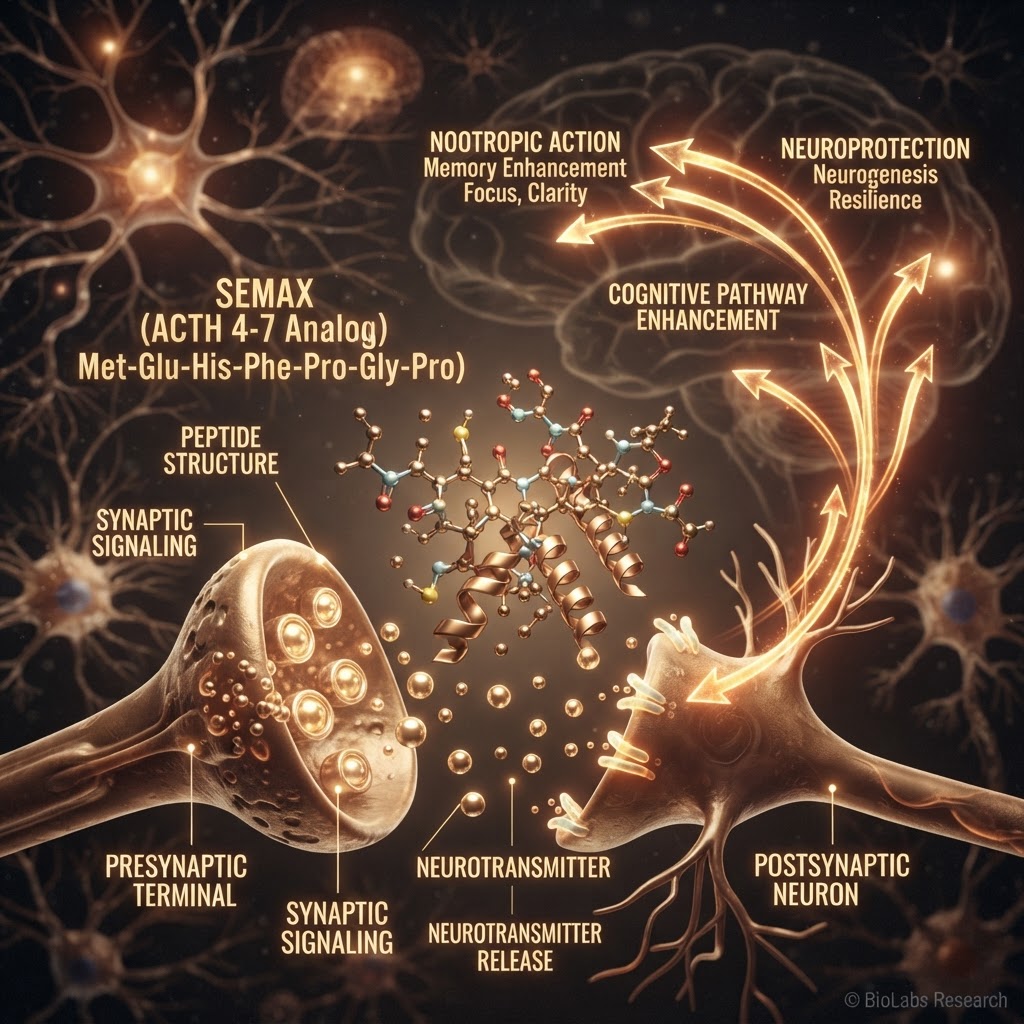
Semax (ACTH 4-7 analog): a heptapeptide with demonstrated neuroprotective signal
Semax is a synthetic heptapeptide built as ACTH(4–7) with a C-terminal Pro-Gly-Pro (PGP) extension. The one-letter sequence is MEHFPGP: Met-Glu-His-Phe-Pro-Gly-Pro. It is not adrenocorticotropin. It is not ACTH(1–24). It is not ACTH(4–10) without the PGP tail. Catalogs that print “Semax” without the seven-letter string have not identified the reagent.
This article is an identity note for laboratory sourcing. Rodent papers exist; they are not a medicine label. This catalog’s listing is a research-use-only peptide, not a registered drug product from any jurisdiction.
The published heptapeptide
PubChem indexes the peptide as CID 9811102 under the title ACTH (4–7), Pro-Gly-Pro-. The computed formula is C37H51N9O10S and the molecular weight is 813.9 g/mol. The public CAS is 80714-61-0.1
| Field | Public listing (PubChem) |
|---|---|
| Common name | Semax; ACTH(4–7)-PGP |
| Sequence | MEHFPGP / H-Met-Glu-His-Phe-Pro-Gly-Pro-OH |
| PubChem CID | 9811102 |
| CAS | 80714-61-0 |
| Formula | C37H51N9O10S |
| MW | 813.9 g/mol |
| Parent fragment | ACTH residues 4–7 (MEHF) plus PGP |
The methionine side chain is the sulfur in that formula. Oxidation of Met to sulfoxide is a known process impurity class for Met-containing peptides; it is a different mass. A COA that never mentions methionine chemistry has not finished identity work. We do not print a house oxidation percentage.
ACTH(4–7)-PGP is not ACTH
Adrenocorticotropic hormone is a 39-residue peptide in the human sequence. Residues 4–10 of ACTH are Met-Glu-His-Phe-Arg-Trp-Gly. Semax keeps 4–7 (MEHF) and replaces the rest of that span with Pro-Gly-Pro. The result is seven residues, not ten, and not thirty-nine. Calling a MEHFPGP vial “ACTH” or “ACTH(4–10)” is a mislabel.
Practical checks on a lot document:
- Sequence line is MEHFPGP or H-Met-Glu-His-Phe-Pro-Gly-Pro-OH (free acid as commonly listed). A C-terminal amide, if present, is a different mass and must be stated.
- Intact mass is argued against 813.9 Da for the free peptide in PubChem’s listing, before salt and net peptide content. If the observed ion is a 39-mer or a 10-mer class mass, you do not have Semax.
- CAS 80714-61-0 should not be pasted onto an ACTH(1–24) or tetracosactide PO.
N-terminal acetylation, C-terminal amidation, and Met(O) are three independent ways to leave the PubChem formula. Each must be named if it is what was synthesized.
Rodent literature is not a drug label
Dolotov and colleagues reported that Semax binds and increases BDNF protein levels in rat basal forebrain in a Journal of Neurochemistry study.2 That paper is rodent laboratory literature. It is cited here so a sourcing file can see the analogue named in a peer-reviewed methods context — ACTH(4–10) analogue language in the title, heptapeptide in practice — not as a clinical claim, not as a cognitive protocol, and not as a reason this catalog exists.
BioLabs Research does not sell Semax as a nootropic, a stroke medicine, or an intranasal product. If a methods section needs the Dolotov paper, it needs the paper, not a storefront paragraph.
This catalog is not the Russian registered drug
Semax has a history as a registered medicinal product in the Russian Federation under that trade name. A lyophilized research-reagent listing on an RUO catalog is not that product. It does not inherit a marketing authorization, a pharmacopoeial monograph, an approved nasal spray device, or a labeled indication. Putting the same seven letters on a vial does not make a drug.
Buyers who need a licensed medicinal product must buy a licensed medicinal product from a licensed channel. This site does not offer that channel. The RUO vial is a chemical, identified by sequence and mass.
Mass, salt, and what we will not print
The 813.9 g/mol figure is the PubChem molecular weight for the free peptide. TFA or acetate counter-ions and residual water change the mass of the powder you weigh. HPLC area% does not capture that. If the experiment is quantitative, demand net peptide content on the lot COA, as in the HPLC note. We will not invent an HPLC% or an NPC% for this SKU.
Related notes: HPLC area% vs net peptide content and How a Serious Lot Is Read.
Catalog card
The Semax catalog page lists the heptapeptide as a laboratory reagent with public identifiers and lot COA on request. Match MEHFPGP and CAS 80714-61-0 to the COA. If those lines disagree, the lot is not the listing.
The mind is not a vessel to be filled but a fire to be kindled. — Plutarch
Semax listing
Research-use-only heptapeptide MEHFPGP. Not the Russian registered drug. Sequence and CAS as public identity. Lot paper on request.
View Semax →References
- National Center for Biotechnology Information. PubChem Compound Summary for CID 9811102, ACTH (4-7), Pro-Gly-Pro-. Formula C37H51N9O10S; MW 813.9 g/mol; CAS 80714-61-0. https://pubchem.ncbi.nlm.nih.gov/compound/9811102
- Dolotov OV, Karazeeva EP, Inozemtseva LS, et al. Semax, an analogue of adrenocorticotropin (4–10), binds specifically and increases levels of BDNF protein in rat basal forebrain. J Neurochem. 2006. PMID 16635254. Cited as rodent laboratory literature naming the analogue, not as a medicine claim. https://doi.org/10.1111/j.1471-4159.2006.03658.x