Research Notes
Catalog identity, COA literacy, and fulfilment notes for laboratory purchasing. Research use only.
All articles

What Is G3-R? Catalog Code, Lot Documents and Safety Data
What is G3-R? What the catalog code means, the 10, 20 and 50 mg vials, how to check a lot against its own COA, and where to find the SDS.

What Is TB-500? Identity, Thymosin β4 and Lot Verification
TB-500 is Ac-LKKTETQ, a 7-residue fragment of thymosin beta-4 (≈889 Da vs 4963 Da). Sequence, mass, MS checks and lot COA fields.

What Is BPC-157? Peptide Identity and Research Context
BPC-157 is a 15-amino-acid synthetic peptide (CAS 137525-51-0). Identity data, lab research context and how to check a lot COA.

What Is Tesamorelin? Identity, Sequence & CAS
Sequence, formula, 5135.9 Da mass, CAS numbers and acetate salt, plus why tesamorelin is both a licensed drug and an RUO reagent.

G1-S, G2-T and G3-R: three catalog codes, three separate lot files
They're separate catalog codes, not grades of one reagent. How to match carton, lot number and COA, and what a real lot file holds.

CJC-1295 with DAC and modified GRF (1–29) are different molecules
CJC-1295 with DAC and modified GRF (1–29) are different molecules with different formulae and masses. How to keep their identity records apart.

MOTS-c: a 16-residue mitochondrial-derived peptide
MOTS-c is a 16-residue mitochondrial-derived peptide (≈2174.6 Da). Sequence, identity fields, storage and the COA checks that matter.

NAD+ as a laboratory biochemical
NAD+ is a dinucleotide redox cofactor (C21H27N7O14P2, ≈663.4 g/mol), not a peptide. Laboratory assay context, identity checks and lot documentation.

GHK-Cu: the copper(II) complex of Gly-His-Lys
GHK-Cu is the copper(II) complex of the tripeptide Gly-His-Lys. Free peptide vs complex, formula and mass, copper binding, and what a lot COA should show.

One vial, two CAS numbers
A blend vial can list two CAS numbers because two molecules are present. That is not a third compound. Check both masses on the lot certificate.

Lot docs, not a purity percentage
A catalog card should not display an invented HPLC area percent. When numbers exist, they live on the lot certificate. Research use only.

DAC vs no-DAC is a formula difference
Drug affinity complex versus no-DAC is a formula difference, not a size option. Those molecules are not listed as catalog SKUs here. Research use only.

Catalog SKUs vs research analogues
A name in the research literature is not automatically a catalog SKU. How to tell listed reagents from analogues, and what to put on the PO and COA.

Thymosin Alpha-1 Is the 28-Residue N-Acetyl Peptide, Not TB-500
Thymosin alpha-1 is the 28-residue N-acetyl peptide, not TB-500. Keep the two catalog names separate when you request lot papers. Research use only.

Tesamorelin / Ipamorelin: Two CAS Numbers on One Vial
One vial can carry two CAS numbers when two sequences are filled. This blend is tesamorelin / ipamorelin and not a medicine. Lot masses belong on the COA.
Semax Is ACTH(4–7)-PGP, Sequence MEHFPGP
Semax is ACTH(4–7)-PGP with sequence MEHFPGP in the public literature. This listing is not a nasal medicine. Lot identity is the observed mass on the COA.

Melanotan II Is a Cyclic α-MSH Analogue, Not a Catalog SKU
Melanotan II is a cyclic analogue discussed in literature and is not a SKU on this catalog. The note exists so purchasers do not conflate names.
Kisspeptin-10 Is the C-Terminal KISS1 Decapeptide Amide
Kisspeptin-10 is the C-terminal KISS1 decapeptide amide in the public literature. Lot identity is the observed mass and sequence on the COA when issued.

KPV Is α-MSH 11–13, Not the Whole Hormone
KPV is the alpha-MSH 11–13 fragment, not the intact hormone. Public identifiers are not a lot assay. Ask for the certificate when you need numbers.
HPLC Area Percent Is Not Net Peptide Content
HPLC area percent and net peptide content measure different things. What each field means and why both belong on the lot docs.

ECM-70 Is a Named Catalog Blend, Not a CAS Number
ECM-70 is a catalog name, not a CAS registry number. This article does not invent a recipe. Identity is the lot certificate when a file is issued.
BPC-157 / TB-500 Blend: Two Sequences, Two Masses
Two sequences in one SKU are not a third CAS number. Why per-compound masses belong on the lot certificate, and no invented mix ratio.
AOD-9604 vs hGH 177–191: Match the Sequence on the Vial
AOD-9604 is Tyr plus hGH residues 177–191 (YLRIVQCRSVEGSCGF). How it differs from 176–191 and 177–191 by sequence and mass, and what a COA should show.
Sourcing Research Compounds: A 2026 Laboratory Guide
A 2026 sourcing note for laboratory purchasers: inquiry checkout, lot papers, and RUO labeling. It is not a shopping coupon page. Research use only.
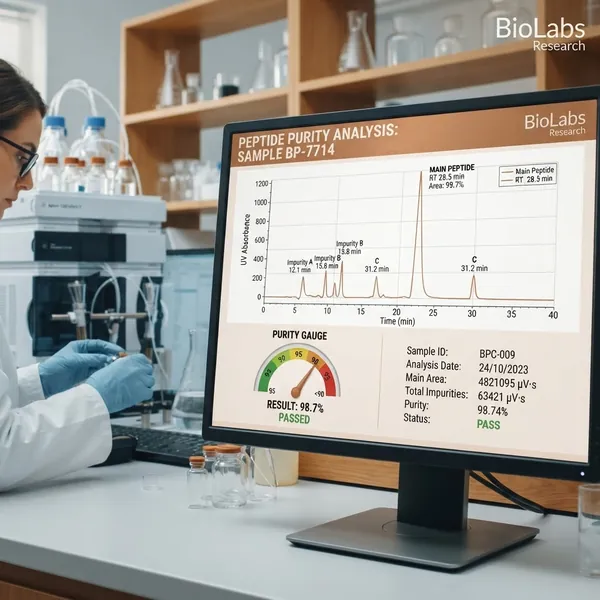
Peptide Purity and COA Explained
A storefront purity number is not a lot measurement. HPLC area percent and net peptide content are different assays; both belong on the certificate.